Introduction
Real estate has always been one of the most trusted investment options, especially in countries like India where owning property is considered both a financial and emotional milestone. As we step into 2026, investors—whether beginners or experienced—are increasingly asking a common question:
Should I invest in land or buy a flat?
Both land and flats come with their own advantages, risks, and return potential. The right choice depends on your financial goals, risk appetite, location, and time horizon.
In this comprehensive guide, we’ll break down everything you need to know about land vs flat investment in 2026, including returns, risks, liquidity, tax benefits, and future trends.
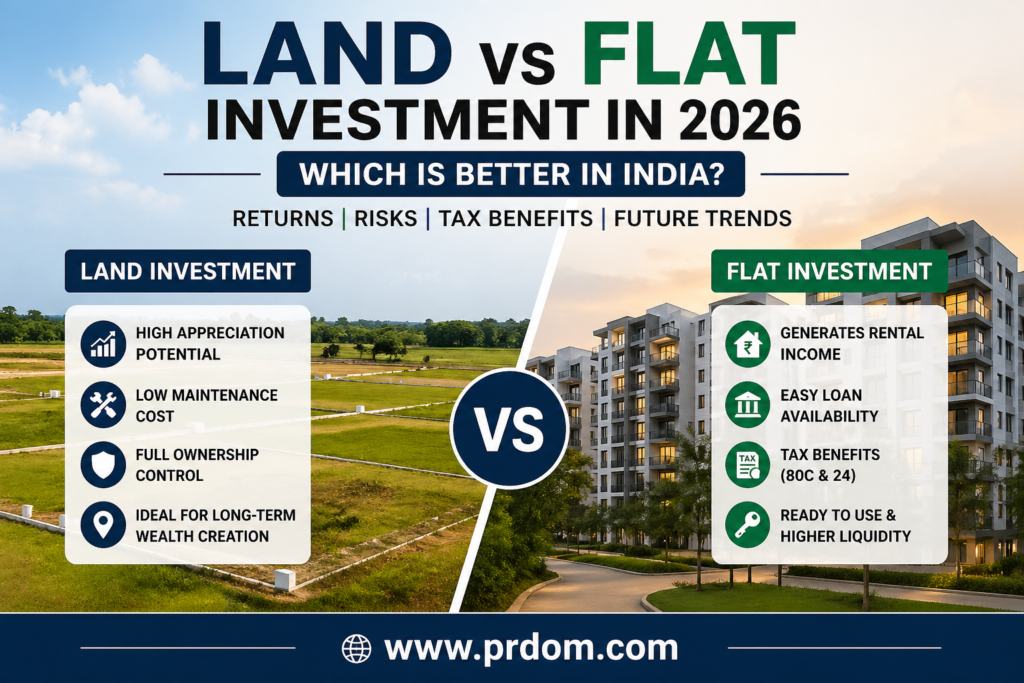
Understanding the Basics
What is Land Investment?
Land investment refers to purchasing a plot of land—residential, agricultural, or commercial—with the expectation that its value will increase over time.
- No construction initially
- Minimal maintenance
- High appreciation potential (in the right location)
What is Flat Investment?
A flat (apartment) is a ready-to-move or under-construction residential unit within a building.
- Comes with amenities (security, lift, parking)
- Can generate rental income
- Easier financing through home loans
Market Trends in 2026
Before comparing, it’s important to understand current trends:
- Tier 2 cities (like Meerut, Lucknow, Indore) are growing rapidly
- Infrastructure projects (expressways, metro) are boosting land value
- Demand for ready-to-move flats is increasing
- Investors are shifting toward long-term appreciation assets
Land vs Flat: Detailed Comparison
1. Price and Affordability
Land:
- Generally cheaper per square foot (especially in outskirts)
- Requires lump sum payment in many cases
- Limited loan options
Flat:
- More expensive due to construction + amenities
- Easy EMI options through home loans
- Better suited for salaried individuals
👉 Verdict: Flats are easier to buy; land can be cheaper but harder to finance.
2. Appreciation Potential
Land:
- Higher appreciation, especially near developing areas
- Value increases with infrastructure growth
- No depreciation
Flat:
- Appreciates slower compared to land
- Building depreciates over time
- Value depends on maintenance and society condition
👉 Verdict: Land usually wins in long-term appreciation.
3. Rental Income
Land:
- No rental income (unless used commercially)
Flat:
- Generates monthly rental income
- Ideal for passive income
👉 Verdict: Flat is better for regular income.
4. Maintenance Cost
Land:
- Almost zero maintenance
- Just boundary/security if needed
Flat:
- Monthly maintenance charges
- Repairs, society fees, sinking fund
👉 Verdict: Land is low-maintenance and cost-effective.
5. Liquidity (Ease of Selling)
Land:
- Can take longer to sell
- Depends heavily on location and demand
Flat:
- Easier to sell in cities
- High demand in urban areas
👉 Verdict: Flats are more liquid.
6. Risk Factor
Land:
- Risk of fraud, illegal land, unclear titles
- Requires legal verification
Flat:
- Safer (especially RERA-registered projects)
- Builder reputation matters
👉 Verdict: Flats are safer for beginners.
7. Tax Benefits
Land:
- No tax benefits on purchase
- Only capital gains tax on sale
Flat:
- Tax deduction on home loan (principal + interest)
- Section 80C & 24 benefits
👉 Verdict: Flats offer better tax advantages.
8. Flexibility
Land:
- You can build as per your choice
- Can hold, sell, or develop later
Flat:
- Fixed structure
- Limited customization
👉 Verdict: Land offers more flexibility.
Pros and Cons Summary
Land Investment Pros
- High appreciation potential
- Low maintenance
- No depreciation
- Full ownership control
Land Investment Cons
- No rental income
- Legal risks
- Harder financing
- Lower liquidity
Flat Investment Pros
- Rental income
- Easy loan availability
- Tax benefits
- Ready to use
Flat Investment Cons
- Depreciation
- Maintenance cost
- Lower appreciation than land
Who Should Invest in Land?
Land is ideal for:
- Long-term investors (5–10+ years)
- People looking for capital growth
- Investors targeting developing areas
- Those who don’t need immediate income
Who Should Invest in Flats?
Flats are best for:
- Salaried individuals
- First-time buyers
- People looking for rental income
- Those who want immediate use (living or renting)
Best Strategy in 2026 (Expert Insight)
Instead of choosing just one, many smart investors are now using a hybrid strategy:
- Buy land in developing areas for long-term gains
- Invest in flats in urban areas for rental income
This way, you balance cash flow + capital appreciation.
Real Example (India 2026)
- Land near expressways or highways has seen 20–40% growth in recent years
- Flats in metro cities give 2–4% rental yield annually
👉 This clearly shows:
- Land = wealth creation
- Flat = income generation
Mistakes to Avoid
- Buying land without legal verification
- Investing in unknown builders
- Ignoring location growth potential
- Buying flats only for appreciation (wrong expectation)
- Not checking resale demand
Future Outlook (2026–2030)
- Land prices will rise in outskirts and Tier 2 cities
- Flats will remain in demand due to urbanization
- Smart homes and gated societies will grow
- Infrastructure will decide property value
Final Verdict: Land vs Flat (2026)
There is no universal “best” option—it depends on your goal.
| Goal | Best Option |
|---|---|
| Long-term wealth | Land |
| Passive income | Flat |
| Low risk | Flat |
| High return | Land |
| Flexibility | Land |
Conclusion
In 2026, both land and flats are strong investment options—but they serve different purposes.
If you want high returns and can wait, land is your best bet.
If you want steady income and lower risk, flats are a better choice.
The smartest investors don’t choose one—they diversify.
❓ Frequently Asked Questions (FAQ) – Land vs Flat Investment 2026
1. Which is better in 2026: land or flat investment?
There is no one-size-fits-all answer. If your goal is long-term wealth creation, land is generally better due to higher appreciation. However, if you want regular rental income and lower risk, investing in a flat is a more suitable option.
2. Is buying land a good investment in India in 2026?
Yes, buying land in developing areas—especially near highways, expressways, and growing Tier 2 cities like Meerut or Lucknow—can offer high returns over time. Land tends to appreciate faster when infrastructure improves.
3. Do flats give better returns than land?
Flats usually provide rental income (2–4% annually), while land offers higher capital appreciation. So:
- Flats = steady income
- Land = long-term profit
4. Is land investment risky in India?
Land investment can be risky if proper legal checks are not done. Issues like unclear titles, encroachments, or disputed ownership can arise. Always verify documents and approvals before purchasing.
5. Can I get a loan for buying land?
Loans for land are available but are more limited compared to home loans for flats. Banks usually offer:
- Lower loan amounts
- Higher interest rates
- Shorter repayment periods
6. Which is easier to sell: land or flat?
Flats are generally easier to sell, especially in urban areas where demand is high. Land may take longer to sell unless it is in a high-growth location.
7. What are the tax benefits of buying a flat vs land?
Flats offer better tax benefits:
- Deduction under Section 80C (principal repayment)
- Deduction under Section 24 (interest payment)
Land does not provide tax benefits at the time of purchase, only capital gains tax applies when selling.
8. Is rental income possible from land?
Typically, land does not generate rental income unless it is leased for commercial purposes. Flats, on the other hand, provide consistent monthly rental income.
9. Which investment is better for beginners?
Flats are generally better for beginners because:
- Lower legal risk
- Easier financing
- Immediate usability
Land requires more research and due diligence.
10. What is the best real estate strategy in 2026?
The best strategy is diversification:
- Invest in land for long-term appreciation
- Invest in flats for rental income
This approach helps balance risk, income, and growth.
11. How does location impact land vs flat investment?
Location is the most important factor:
- Land near infrastructure projects grows faster
- Flats in prime urban areas generate better rent
Always choose properties in high-demand and developing locations.
12. Should I buy a flat for living or investment?
If you need a home, buying a flat is a practical choice. But if your goal is purely investment, you should compare:
- Rental yield
- Appreciation potential
- Market demand
Disclaimer: This article is for informational purposes only and does not constitute financial, investment, or professional business advice; please conduct your own research before starting any venture.
**** *****Read more about Buy vs Rent House, Which is best?
*********Read more about Commercial vs Residential Property in India: Where Should You Invest ?
*********How to Find the Perfect real estate Property: A Complete Buyer’s Guide.
**** ****Find and List your dream property at www.prdom.com
**** ****Calculate EMI Loan by using Prdom EMI loan calculator
******** Read more Best Cities for Property Investment– Country Wise High-Growth Locations:2026
********Read more 100 Best Future Business Ideas
Reach at Ministry of Housing and Urban Affairs (Government of India) official portal
- Best Places to Visit in India During Summer and Winter
- Land vs Flat Investment in 2026: Which is Better for Long-Term Wealth?
- What Are the Best Cities for Real Estate Developers in India & the World? (2026 Guide)
- Property Investment During War: Risks, Opportunities, and Smart Strategies or 10 Facts About Property Investment During War Every Investor Should Know & Should You Invest in Property During War?
- 100 Best Future Business Ideas
Comments